When your wrist’s in a cast or brace, the big questions are: “what can I do now?” and “when can I get back to normal?” Here’s a realistic, no-drama roadmap. (Always follow your clinician’s protocol—fractures and surgeries differ!)
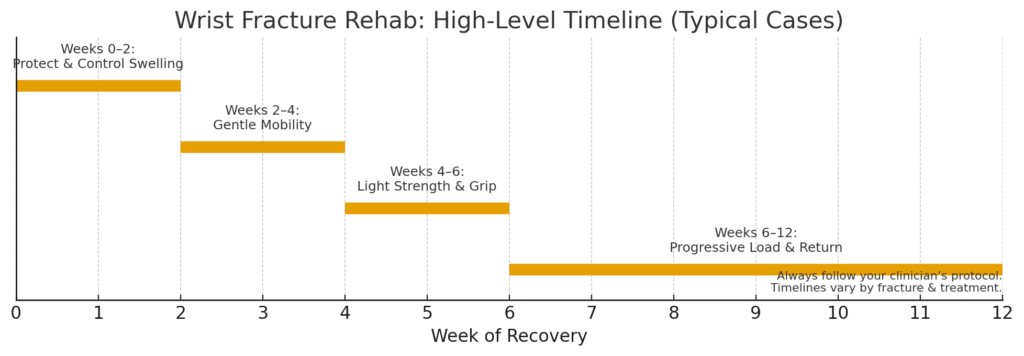
Weeks 0–2: Protect & Calm Down Inflammation
- Goals: protect the fracture, reduce pain/swelling, keep the rest of the limb moving.
- Do: finger opens/closes, thumb opposition, gentle shoulder & elbow range of motion, elevation above heart, short frequent icing (10–15 min, towel barrier).
- Avoid: lifting, pushing, pull-ups/planks, twisting jar lids, falling risk.
- Green flags: swelling trending down, fingers moving easier each day.
Weeks 2–4: Gentle Mobility (if cleared)
- Goals: start restoring motion without stressing the bone.
- Do (brace off only if approved):
- Wrist flex/extend: rest forearm on table, move hand like waving—small, pain-free arcs, 10–12 reps.
- Pronation/supination: elbows tucked, turn palm up/down in a small arc.
- Tendon glides: straight hand → hook → full fist → straight, 5–8 cycles.
- Rule of thumb: slight stretch = OK; sharp pain or swelling next day = too much.
Weeks 4–6: Light Strength & Grip
- Goals: rebuild basic strength and coordination.
- Do:
- Isometrics (no movement): press hand gently into the other palm in 4 directions, 5×5-sec holds.
- Towel squeezes / soft putty: 2–3 sets of 10–15 easy squeezes.
- Radial/ulnar deviation: hold forearm on table, move hand side-to-side in small range.
- Still avoid: heavy loading, impact, push-ups, handstands, heavy carries.
Weeks 6–12: Progressive Loading & Return to Sport
- Goals: restore full range, strength, and confidence.
- Progression ideas:
- Light resistance (0.5–1 kg dumbbell or band) for wrist curls, reverse curls, pronation/supination.
- Closed-chain prep: incline wall push-ups → counter push-ups → kneeling → floor.
- Grip & forearm endurance: farmer carry with light kettlebell, 30–45 s carries, 3–4 rounds.
- Sport skills: add dribbling/passing/catching or weight training patterns only when day-after symptoms are calm.
Pain & Progress Checks
- The 24-hour rule: if pain >5/10 during, or if swelling/stiffness spike the next day, scale back by 25–50%.
- Range first, then load: aim for pain-free motion before adding resistance.
- Symmetry goal: by ~10–12 weeks many people approach 80–90% of the other side for daily tasks (varies).
Nutrition & Recovery Boosters
- Protein: ~1.6–2.2 g/kg/day to support healing.
- Micros: calcium (600–1000 mg/day from food), vitamin D (per doctor), vitamin C and zinc from whole foods.
- Lifestyle: 7–9 hours sleep, no smoking (slows bone healing), manage stress.
Red Flags—Call Your Clinician
- Numbness/tingling worsening, fingers turning pale/blue, unbearable pain, fever, cast/brace too tight, or new deformity after a fall.
Leave a Reply